By Brian Stevens, Former Beyond Borders Engagement Director
To spend time with Freda, a Beyond Borders program coordinator, is to be reminded what joy, generosity, and commitment look like when they are shared freely and lived without reserve.
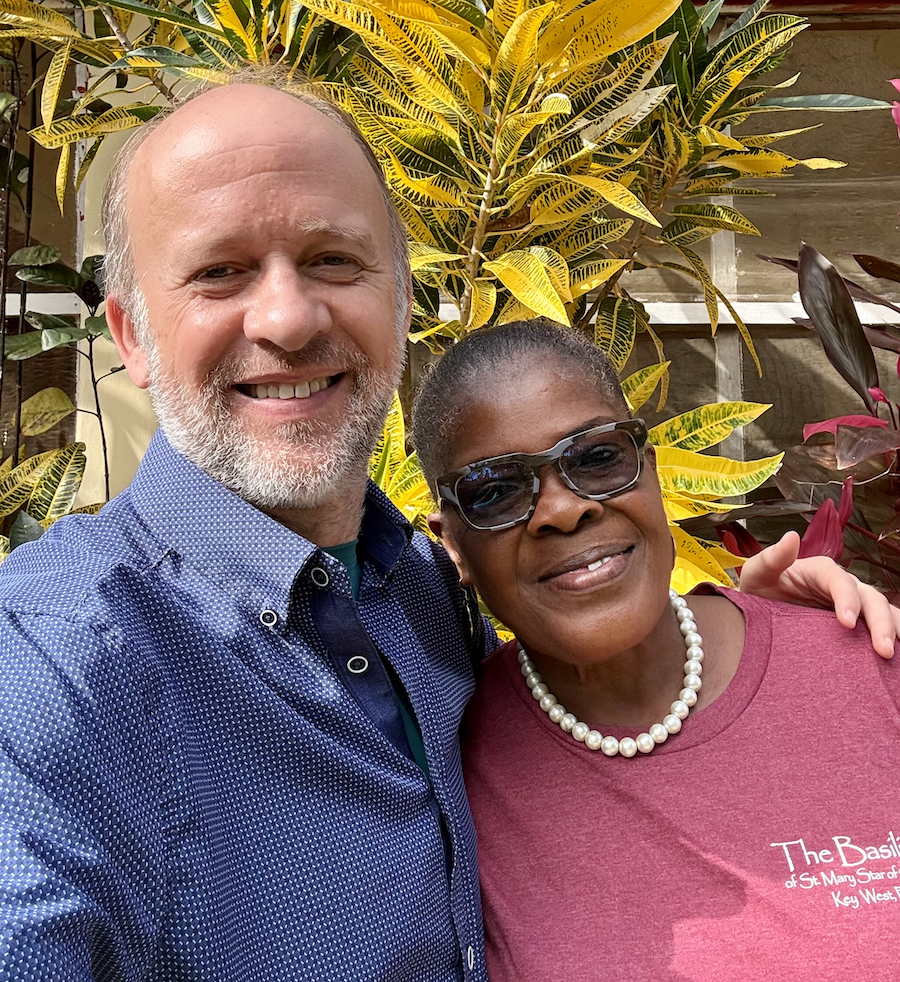
I arrived at Freda's home in the community of Tipalmis on Lagonav Island on Friday evening, just as the sun was dropping low and the air was cooling. It had been nearly three years since my last visit.
Freda wasn’t home yet—she was at her parish, St. Lucy, leading choir practice, after having spent the day in a far-off community meeting with graduates of Beyond Borders’ Family Graduation Program. That felt exactly right.
She arrived a little later, and within minutes we were gathered around the table, offering a prayer before dinner and sharing a meal.
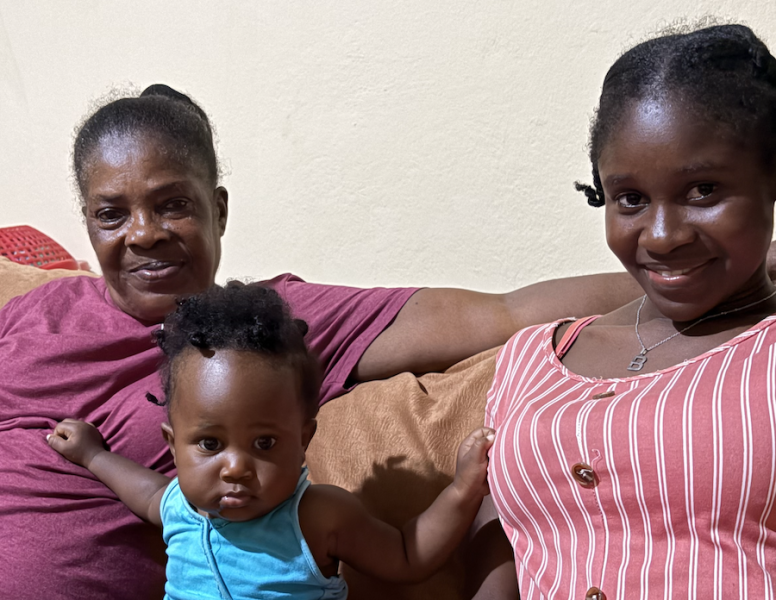
Freda’s home is full in every sense of the word. Living with her are her daughter, Lovelandie, her eight-month-old granddaughter Smaylee, and Mia—Freda’s longtime cook and housekeeper—along with Mia’s husband and their three children. Everyone is welcome here.
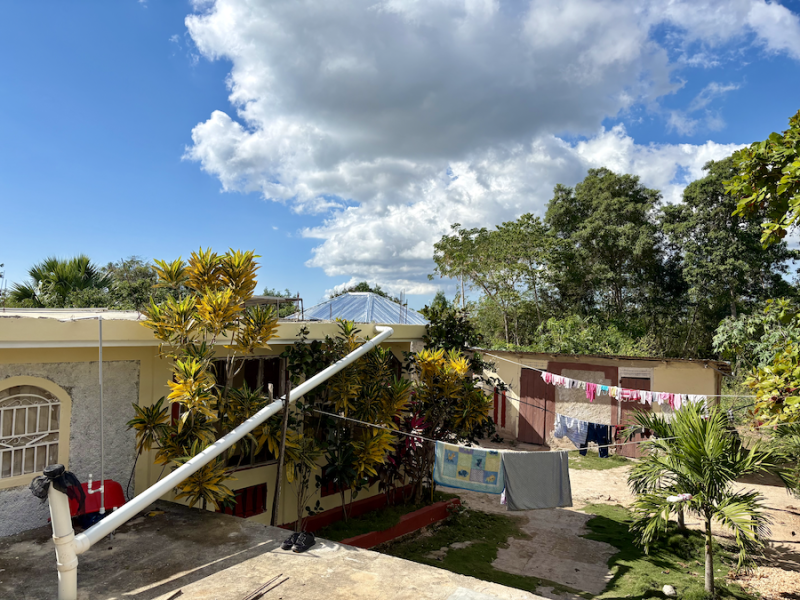
The lakou, as they say in Haitian Creole about a family compound, hums with life: children, conversation, laughter, chickens and roosters, dogs and cats weaving through it all.
Much of what we ate came from Freda’s yard, which is itself a kind of quiet testimony to the value she places in the land.
There are papayas, coconuts, cherries, limes, oranges, breadfruits, avocados, lettuce, peppers, plantains, parsley, pumpkin, yuca, citronella, basil, amaranth greens, and local medicinal and culinary herbs.
The land gives, and Freda gives right back—sharing what she has.
Saturday and Sunday were not restful days for Freda, and it was clear that this is how she prefers it.
On Saturday afternoon, before another choir practice, she took me to the schoolyard of her parish school to meet her pastor, Father Gilbert Saturné.
We spoke for more than an hour while Freda was across the way, leading the choir.
Fr. Gilbert reminded me of the instrumental role Freda played in making that school possible. Years ago, when I was asked to help connect a priest in the U.S. to a rural parish in Haiti in need of accompaniment, it was Freda who I turned to.
She did what she always does: she opened doors, made relationships possible, and then stayed with the work.
Today, the school serves 220 primary students.
Sunday began early.
At 5:30 a.m., Freda, one of Mia’s sons who serves as an altar server, and I rode to the church in the pre-dawn light.
By 6:30, Freda was preparing the altar and leading the choir in the rosary before the 7 a.m. Mass.
The choir—under her steady, joyful leadership—animated the liturgy in a way that was deeply moving. It was a privilege to be there, to watch how prayer, music, and community flowed together so naturally.
After Mass, Freda stayed to speak with parishioners—never rushing anyone—before we returned home.
She suggested I take a nap since it had been an early morning. She said she would do the same.
Three hours later, I woke to her gentle knock at the door: lunch was ready. When I asked how long she had rested, she said matter-of-factly, “About fifteen minutes.” The rest of the time, she had been typing up the song sheet for next Sunday’s Mass.
That afternoon, Freda was off again—this time to a meeting under a mango tree for one of the local savings and loan groups she belongs to.
From there, we went straight back to the church for yet another choir practice, which lasted until the sun set.
The day ended with a shared meal and time together as a family.
Monday morning came quickly.
Up again at 5:30, we left at 6:00 for the 6:30 a.m. Mass. When we arrived, it was still dark. Freda unlocked the doors, lit the candles, set out the lectionary—and then quietly took up a mop to clear rainwater that had pooled inside the church overnight because of a leaky roof.
This is who she is. There is nothing she won’t do.
Freda is the life and soul of her parish, but the parish itself bears heavy burdens.
The priest receives no salary from the Archdiocese. He purchases the hosts for the Eucharist with his own money. The responsibility for repairing the church roof rests squarely on his shoulders.
And yet, during the collection, parishioners approach with dignity and intention, offering what they can. No one is invisible. No gift is too small.
When needs arise that would otherwise go unmet, Freda and her family—especially her children in the United States—quietly step in whenever they are able, offering support, not as benefactors, but as family.
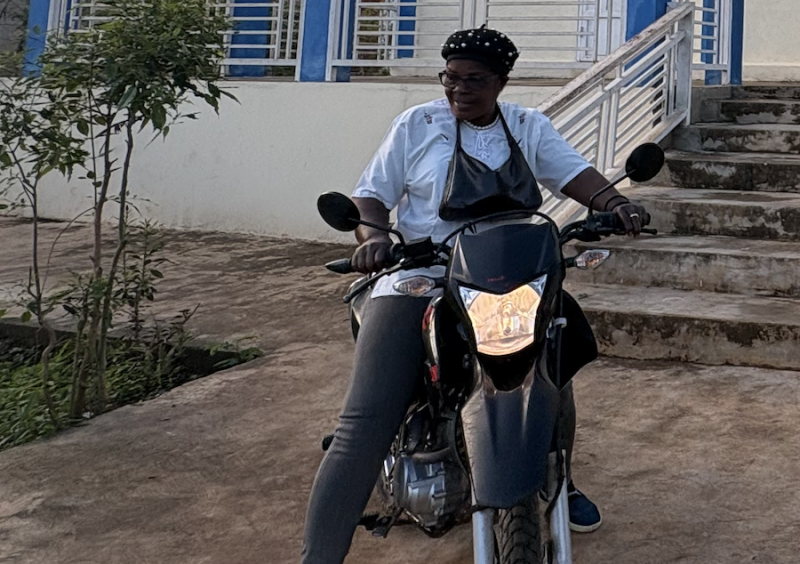
After Mass, Freda and I climbed back onto her motorcycle for the hour-long ride to the Beyond Borders office.
My weekend was over. I felt refreshed, revived, and deeply grateful.
I treasure Freda’s friendship. I also consider her one of my spiritual guides.
Many of you reading this already know much of what I’ve shared: her work with Beyond Borders, her tireless presence in her parish, her leadership as the first female president of a local farmers’ association, her selection for advanced training in the Family Graduation Model in Bangladesh, and her service on the local community board of the Matènwa Community Learning Center.
These roles don’t define her so much as they reveal what has always been true—her attentiveness, her steadiness, and her instinct to lead by serving.
This community is not poor in spirit.
It is rich in commitment, in faith, and in love. And Freda stands quietly at the center of it all.